Launch offer — valid today only

📄 Digital book in PDF · read it on your phone or print it

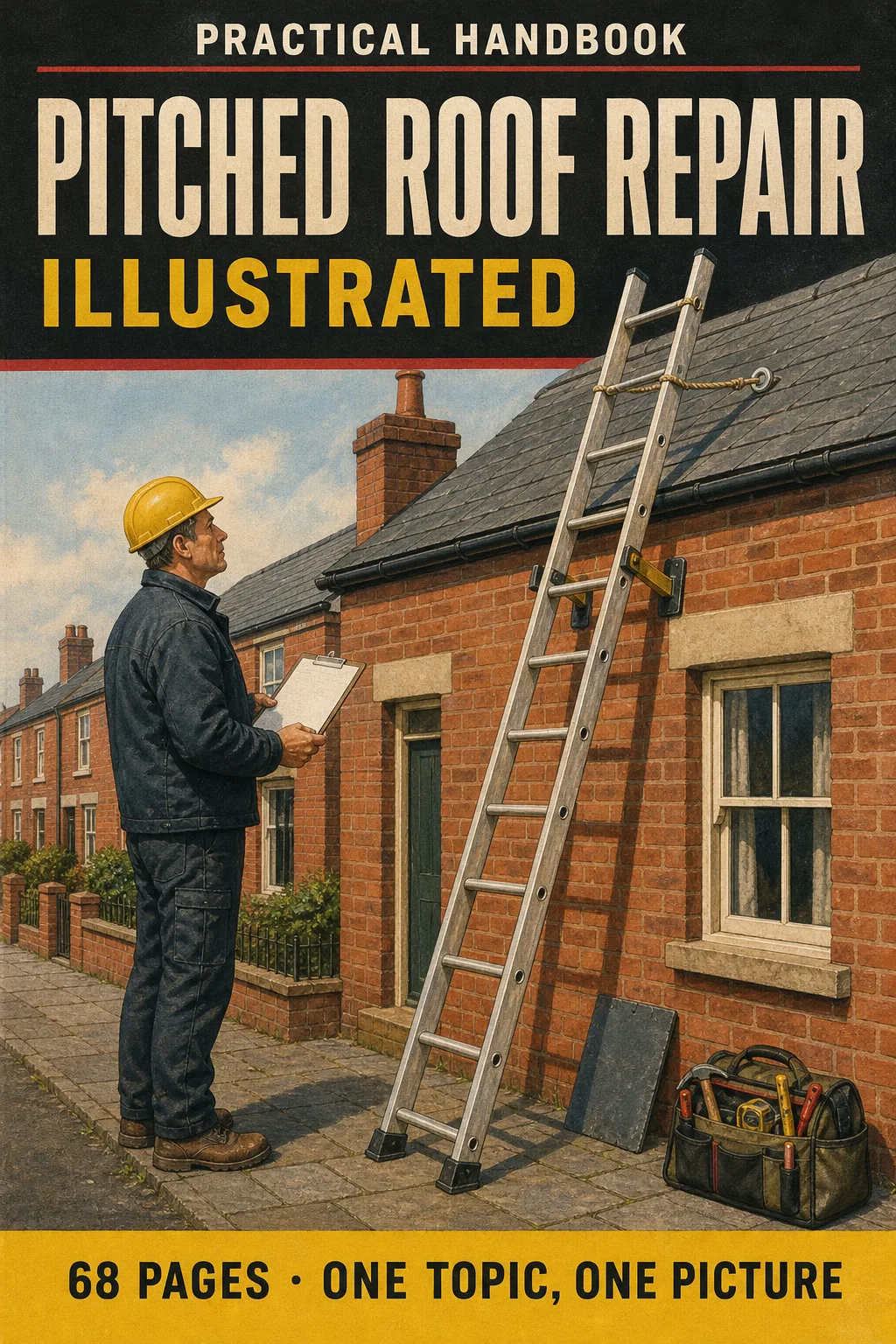
Pitched Roof Repair Illustrated: Every Slate, Tile and Lead Repair in Drawings One Repair on Every Page

Tracing the leak from the loft, the 1 in 4 ladder rule, slipped slates and tingles, broken tiles, ridge tiles, lead step flashing, valleys and gutters. Every topic has its own page: the drawing first, then what you need to remember. 68 illustrated pages.

YES, SHOW ME MY ROOF IN DRAWINGS

🔒 Secure checkout · PDF by email · 30-day guarantee

Every topic, its own pageEvery repair drawn step by step, with the explanation alongside
68 illustrated pages9 parts, from your roof in cross-section to your yearly roof check
Up-to-date sourcesHSE work at height guidance, BS 5534 and lead sheet guidance
PDF by emailFormat

Look Inside the Book

Every page has one large drawing and a box with the measurements, rules and safety checks you need to know:

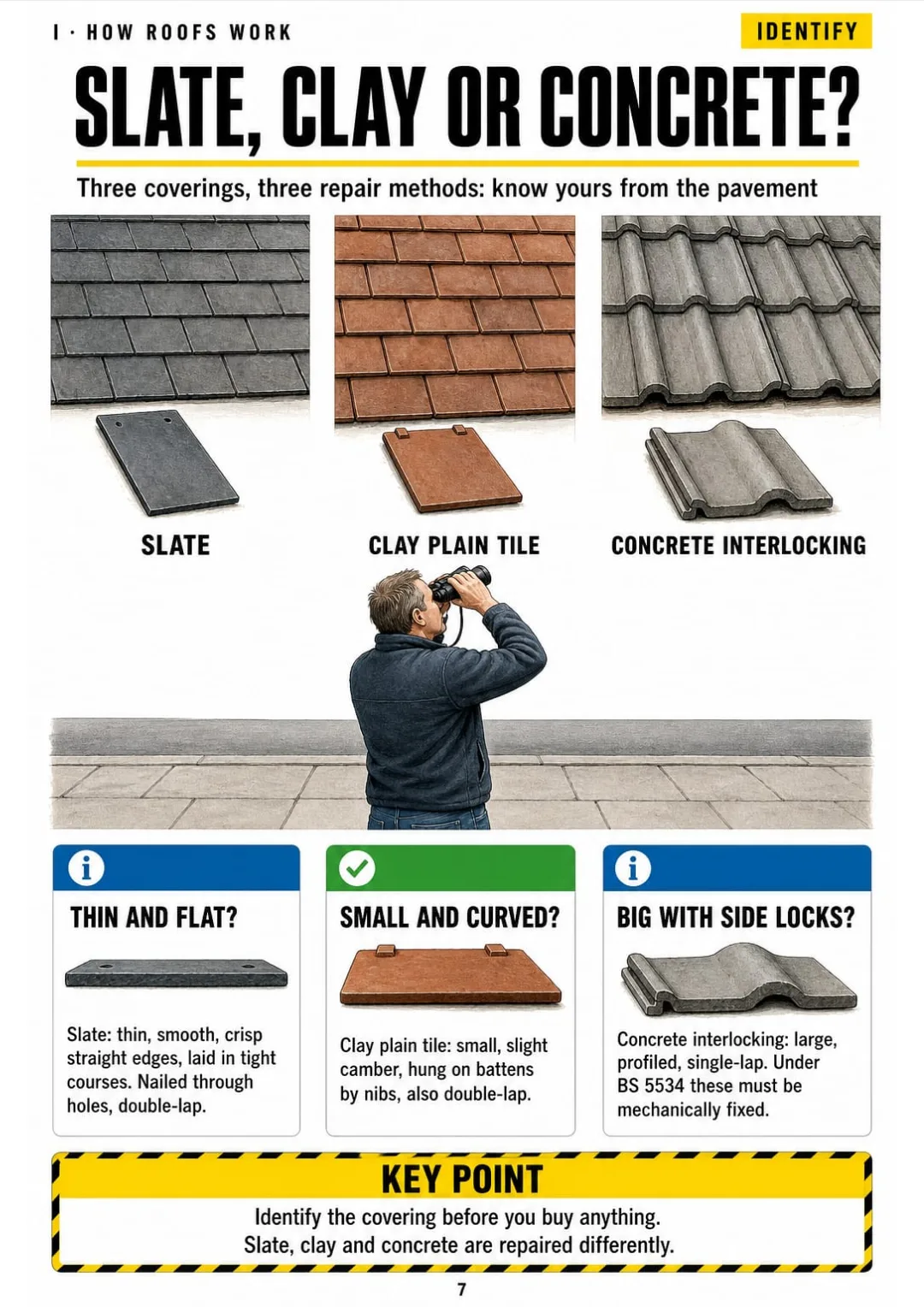
Slate, clay plain tile or concrete interlocking: three questions answered from the ground.
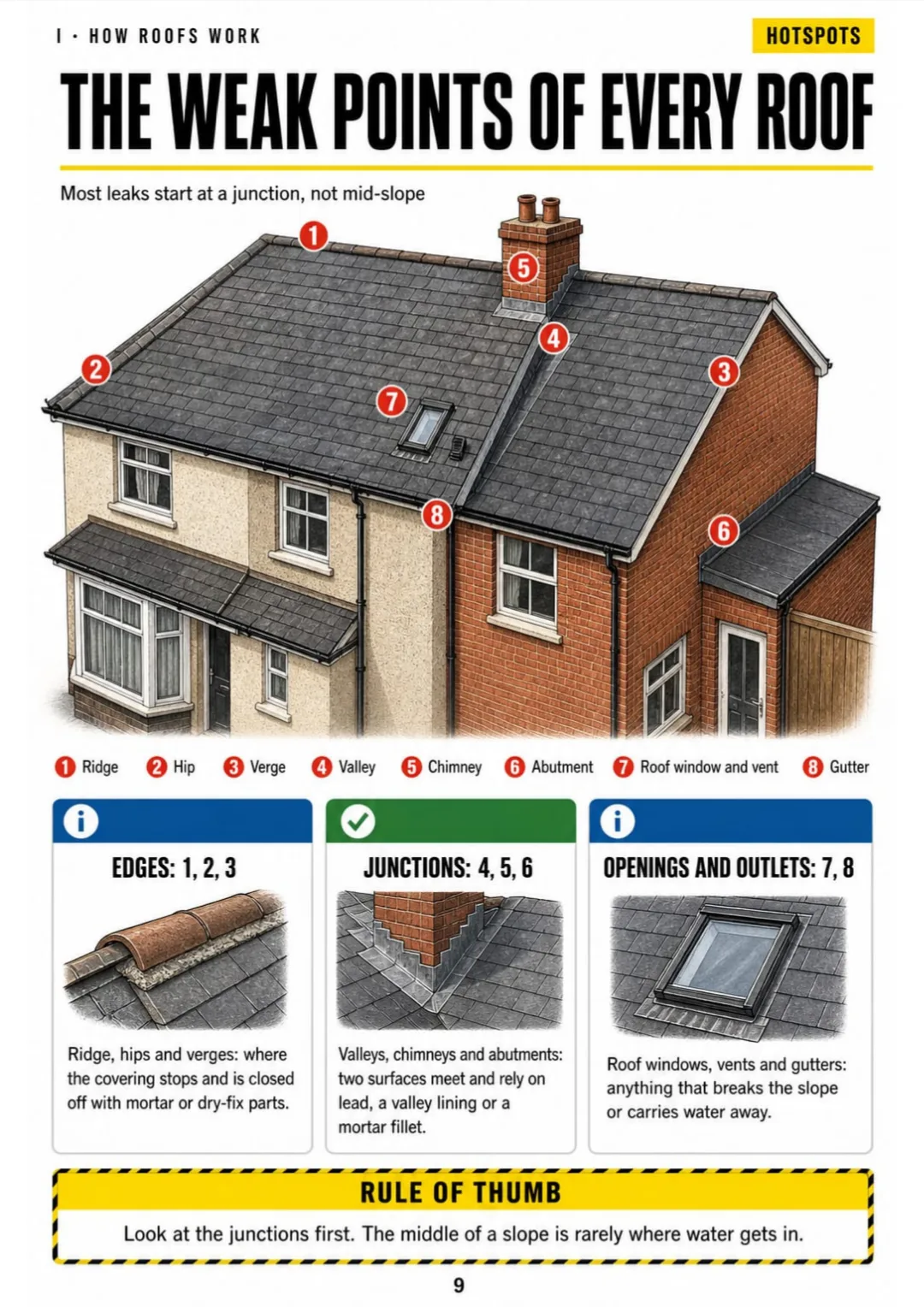
Ridge, hips, verges, valleys, chimney, abutments, windows and vents, gutters: the eight hotspots.
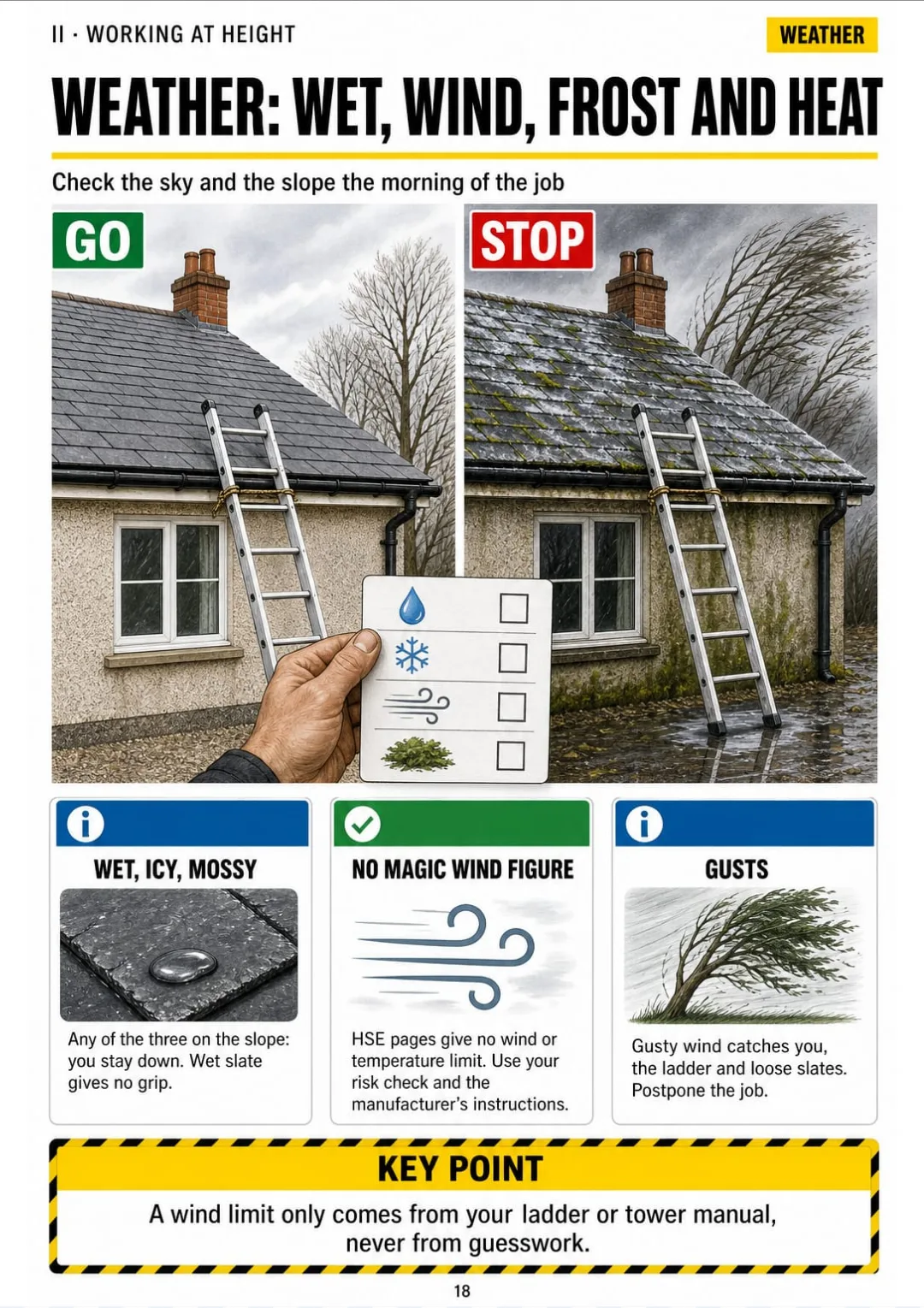
No HSE wind limit exists: your manual and a morning check decide.
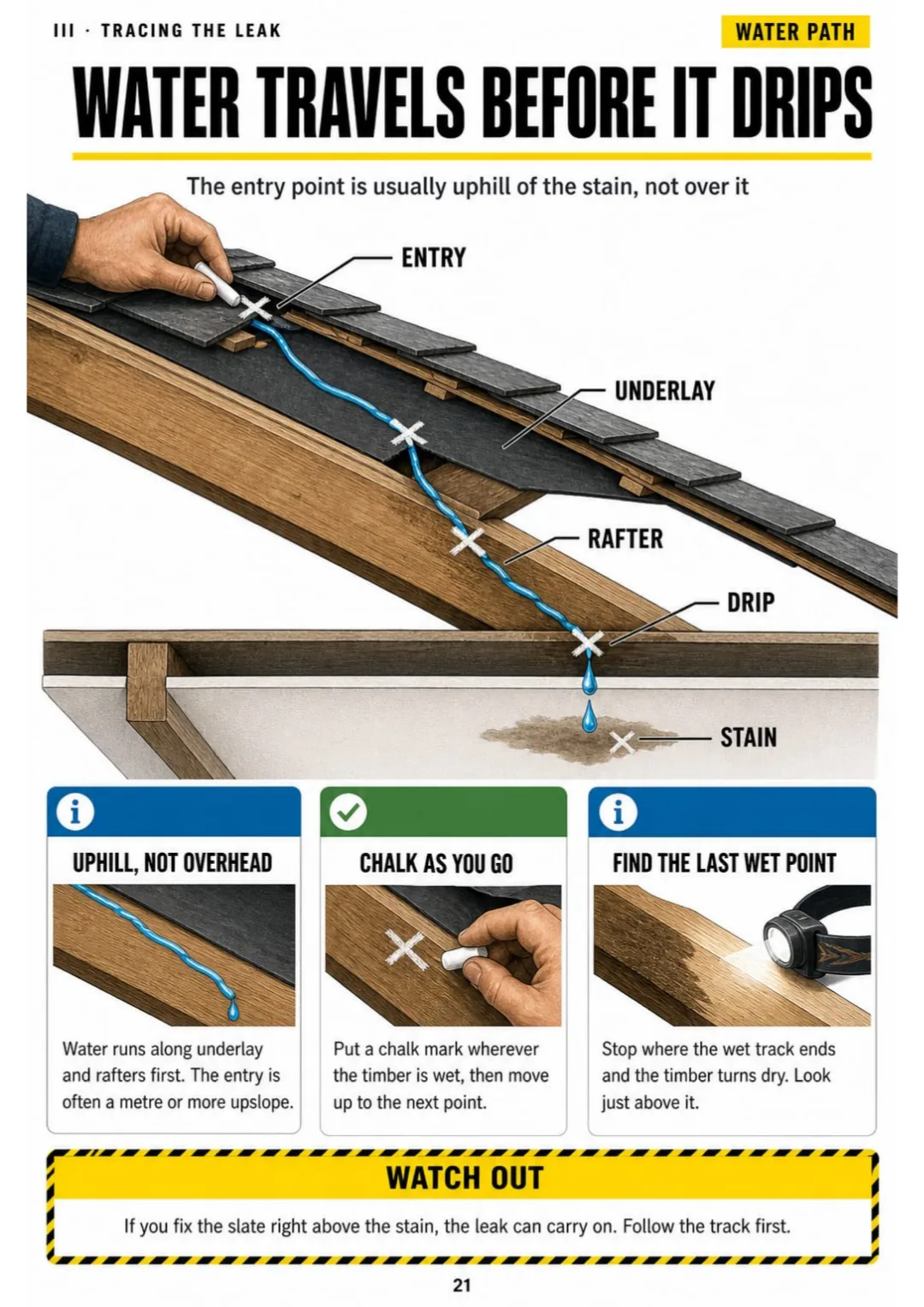
Water runs down the underlay and rafters, often a metre or more before it drips.
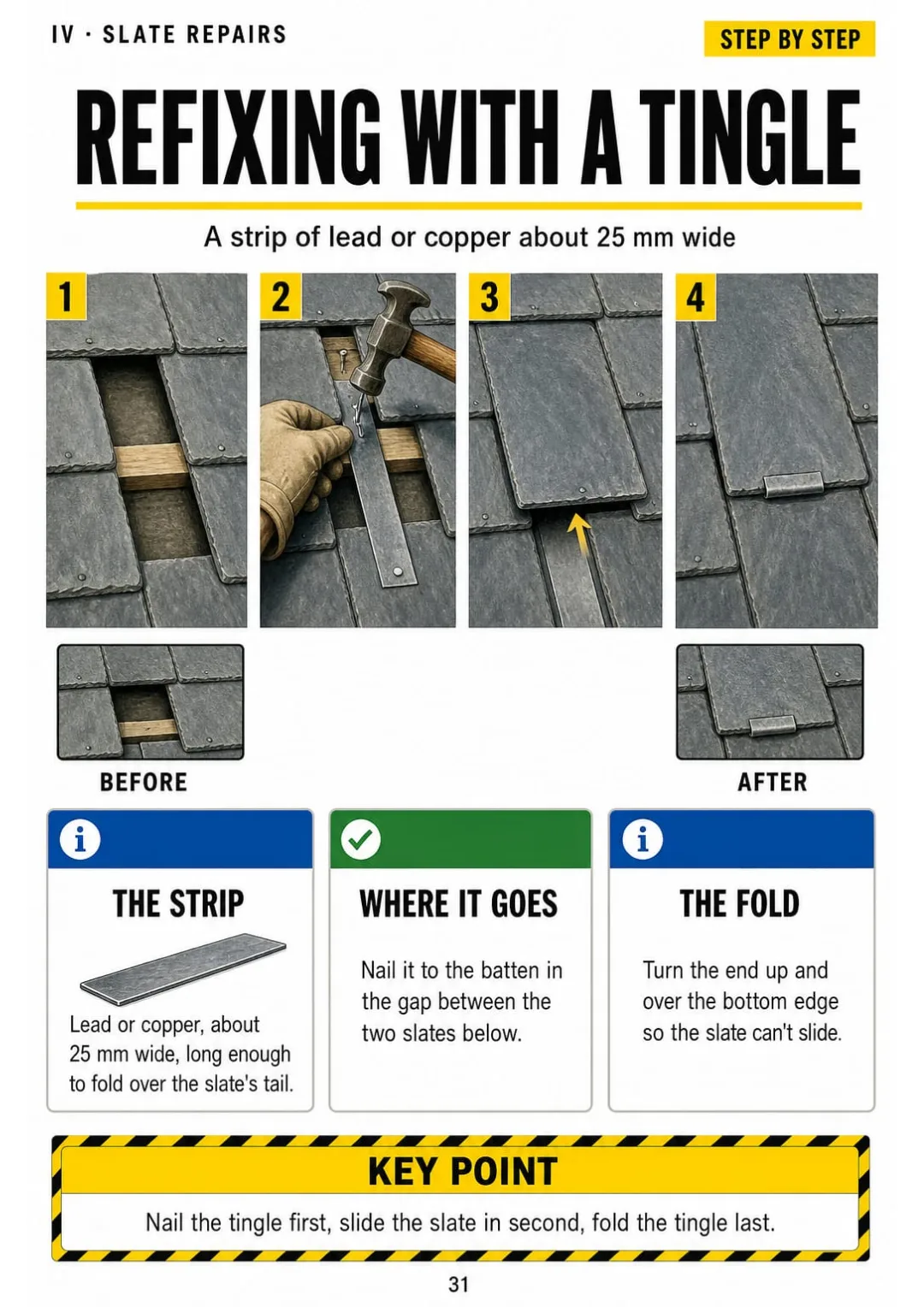
A 25 mm lead or copper strip, nailed to the batten and folded over the slate.
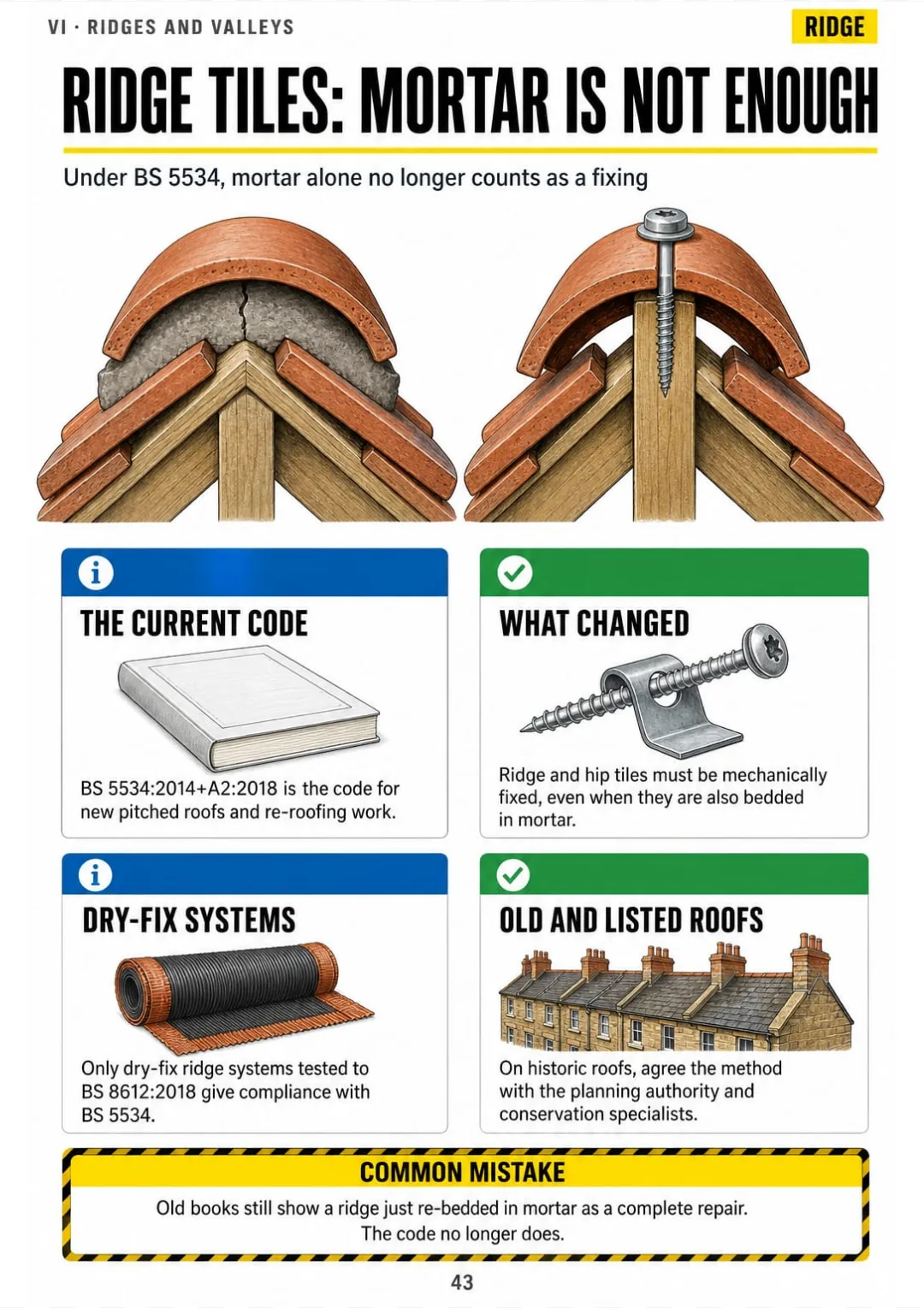
BS 5534: ridge and hip tiles must be mechanically fixed, even when bedded in mortar.
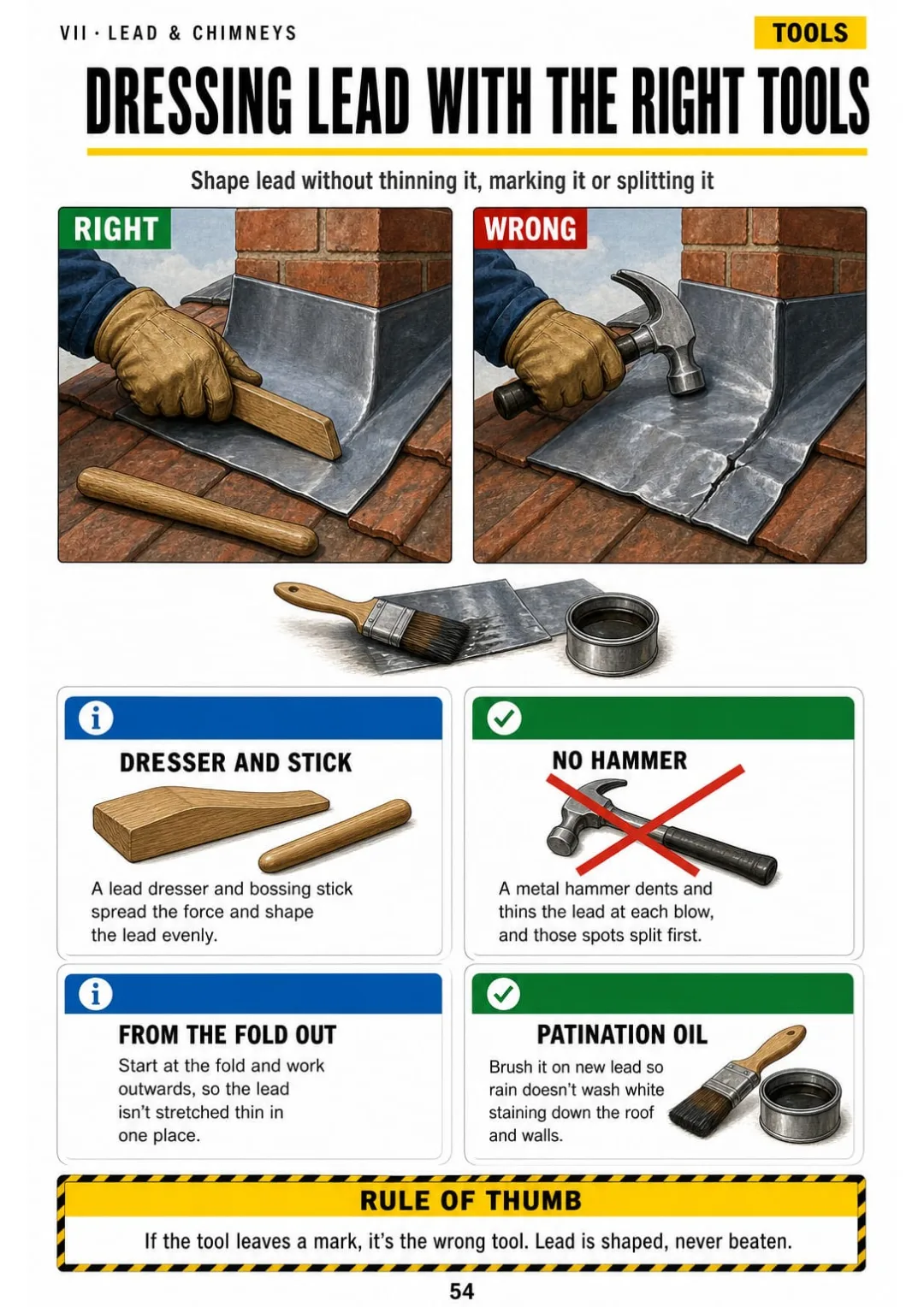
Dress lead with a dresser and bossing stick, from the fold outwards, then oil it
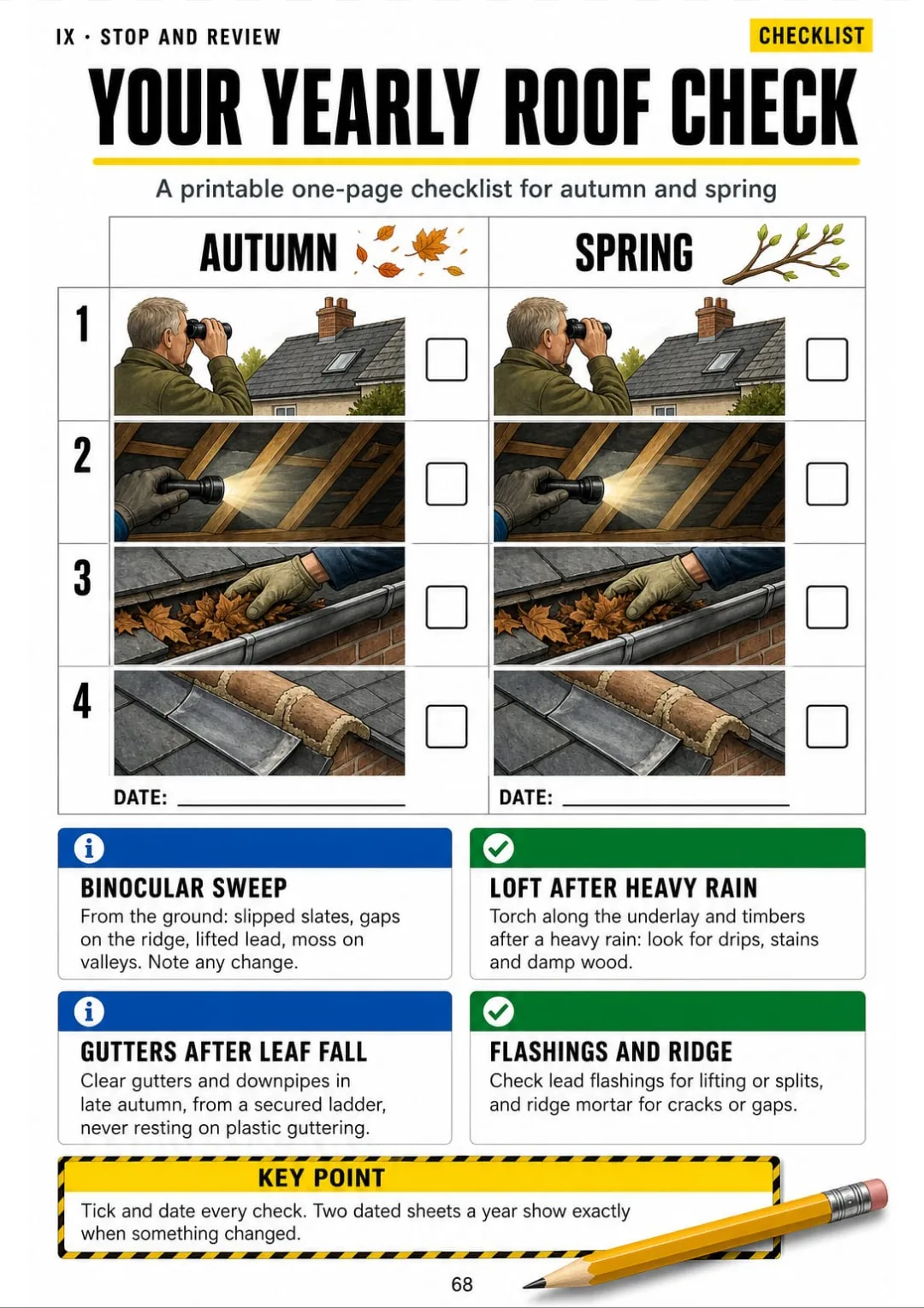
Autumn and spring: binoculars, loft torch, gutters, flashings and ridge, ticked and dated.

Swipe to see more →

These are real pages from the book. The table of contents is the full one: 9 parts and 64 topics.

The Problem Isn't You. It's How It Was Explained to You.

You're in the garden with a borrowed extension ladder, looking up at a slipped slate above the bay window. You know there's an angle it should stand at, but not which one.

The guidance you found online covers it in paragraphs: ratios, footing, tying, pre-use checks, all in one block. You read it, step outside, and the numbers have gone.

No HSE wind limit exists: your manual and a morning check decide.

In the book, the ladder rule is one drawing: the ladder against the wall, 1 unit out for every 4 up, 75°, marked on the ground, with the pre-use check in a box beside it.

The rest has its own page too: footing and tying the ladder, the roof ladder, the weather that keeps you on the ground, tracing the leak from the loft, refixing a slate with a tingle.

You set the ladder and check it, or see it's a roofer's job and stay on the ground, without going back to the screen to look it up again.

COMPARE FOR YOURSELF

The Same Topic, Two Ways to Learn It

THIS
  • The manual: line after line
  • Roof weak points described only in words
  • You go up the ladder still unsure
Water ingress in pitched roof coverings occurs predominantly at discontinuities in the covering rather than across the main field of slates or tiles. Such discontinuities include the ridge and hips, where cappings are bedded or mechanically fixed; the verges at gable ends; valleys formed at the intersection of roof slopes; junctions with chimney stacks and abutment walls, where flashings are required; penetrations for roof windows and ventilation terminals; and the eaves, where discharge into rainwater goods is necessary to prevent saturation of fascia boards.
FOR THIS
  • The roof's weak points in one drawing
  • The eight hotspots in a box
  • You see it and you get it
Ridge, hips, verges, valleys, chimney, abutments, windows and vents, gutters: the eight hotspots.
CONTENTS

Take a Look at the 9 Parts and 64 Topics

How a roof keeps water out, working safely at height, tracing the leak, slate and tile repairs, ridges and valleys, lead and chimneys, gutters, and when to stop: 68 pages, all illustrated

IHow a pitched roof keeps water out · pp. 5-11
  1. Your roof in cross-section
  2. Headlap: why slates overlap three deep
  3. Slate, clay or concrete: identify your roof
  4. Underlay: felt, membrane or nothing at all
  5. The weak points of every roof
  6. Roof words a roofer will use
  7. How roofs fail with age
IIWorking safely at height · pp. 12-19
  1. Before you climb: the five questions
  2. The 1 in 4 ladder rule
  3. Footing, tying and the 1 metre rule
  4. Three points of contact
  5. The roof ladder: never walk on slates
  6. Ladder, tower or scaffold?
  7. Weather: wet, wind, frost and heat
  8. Fragile surfaces and the stop signs
IIITracing the leak from the loft · pp. 20-28
  1. Always the same order: stain, timber, underlay, roof
  2. Water travels: why the leak is rarely above the stain
  3. Loft safety and kit
  4. Measuring from inside to find it outside
  5. Leak or condensation?
  6. Reading the stain: where it sits tells you where to look
  7. Daylight, damp timber and old repairs
  8. Spotting from the ground with binoculars
  9. The hose test, done carefully
IVSlate repairs · pp. 29-35
  1. Slipped slate: why it happens
  2. The slate ripper: cutting the old nails
  3. Refixing with a tingle
  4. Refixing with a slate hook
  5. Matching a replacement slate
  6. Cutting and holing a slate
  7. Cracked and delaminating slates
VTile repairs · pp. 36-42
  1. Plain clay tiles: nibs and nails
  2. Concrete interlocking tiles
  3. Wedging tiles up without breaking them
  4. Clips and fixings on modern tiles
  5. Matching a replacement tile
  6. Moss and lichen: what to do and what not to do
  7. Vents and roof windows
VIRidges, hips, verges and valleys · pp. 43-49
  1. Ridge tiles: mortar is not enough any more
  2. Re-pointing a loose ridge
  3. Re-bedding a ridge tile
  4. Hips: the same problem on a slope
  5. Mortar verges and dry verges
  6. Valleys: where two slopes meet
  7. Eaves: the bottom edge
VIILead, chimneys and abutments · pp. 50-57
  1. Lead codes and their colours
  2. Step flashing against a wall
  3. Apron and cover flashings
  4. Chasing, wedging and pointing lead in
  5. Dressing lead with the right tools
  6. Patching split lead
  7. Chimney flaunching and the back gutter
  8. Lean-to abutments and extensions
VIIIGutters and downpipes · pp. 58-62
  1. How a gutter should fall
  2. Clearing gutters and downpipes safely
  3. Leaking joints in plastic gutters
  4. Cast iron gutters on old houses
  5. Overflowing gutters and wall damp
IXStop, record and review · pp. 63-68
  1. When to stop and call a roofer
  2. Emergency cover after a storm
  3. Recording storm damage
  4. Repairs, permissions and the 25% rule
  5. Most frequent repair mistakes
  6. Your yearly roof check

One Page, One Topic, All Clear

Think of it this way:

It's the morning after a storm. There's a damp patch on the bedroom ceiling and you need to know where the water is getting in before the next rain.

You open the page on water travelling and see the roof in cutaway: the water running down the underlay and along the rafter, often a metre or more from where it drips, and the order to check it: stain, timber, underlay, roof.

A 25 mm lead or copper strip, nailed to the batten and folded over the slate.

The same goes for the 1 in 4 ladder rule, refixing a slate with a tingle, ridge tiles that need mechanical fixing and step flashing against a wall: each one on its own page.

Pitched Roof Repair Illustrated is 68 illustrated pages in 9 parts, ending with when to stop and call a roofer and your yearly roof check.

What you see drawn, you don't have to memorize.

What's Inside Pitched Roof Repair Illustrated:

Ipp. 5-11

How a pitched roof keeps water out

Your roof in cross-section, headlap, slate, clay or concrete, underlay, the weak points, the words a roofer uses and how roofs fail with age.

IIpp. 12-19

Working safely at height

The five questions before you climb, the 1 in 4 rule, footing and tying, three points of contact, the roof ladder, tower or scaffold, weather and fragile surfaces.

IIIpp. 20-28

Tracing the leak from the loft

The fixed order (stain, timber, underlay, roof), how water travels, loft safety, measuring inside to find it outside, leak or condensation, binoculars and the hose test.

IVpp. 29-35

Slate repairs

Why slates slip, the slate ripper, refixing with a tingle or a hook, matching, cutting and holing a slate, cracked and delaminating slates.

Vpp. 36-42

Tile repairs

Plain clay tiles, concrete interlocking tiles, wedging tiles up, clips and fixings, matching a tile, moss and lichen, vents and roof windows.

VIpp. 43-49

Ridges, hips, verges and valleys

Ridge tiles and mechanical fixing, re-pointing and re-bedding a ridge, hips, mortar and dry verges, valleys and eaves.

VIIpp. 50-57

Lead, chimneys and abutments

Lead codes and colours, step, apron and cover flashings, chasing and pointing lead in, dressing tools, patching split lead, chimney flaunching and lean-to abutments.

VIIIpp. 58-62

Gutters and downpipes

How a gutter should fall, clearing gutters safely, leaking plastic joints, cast iron gutters and overflows that soak the wall.

IXpp. 63-68

Stop, record and review

When to stop and call a roofer, emergency cover after a storm, recording damage, permissions and the 25% rule (when a repair counts as renovation under Building Regulations), the most frequent repair mistakes and your yearly roof check.

At the end of the book: A stop-and-call-a-roofer page, the most frequent repair mistakes and a yearly roof check to tick and date.

Plus: 2 Free Books

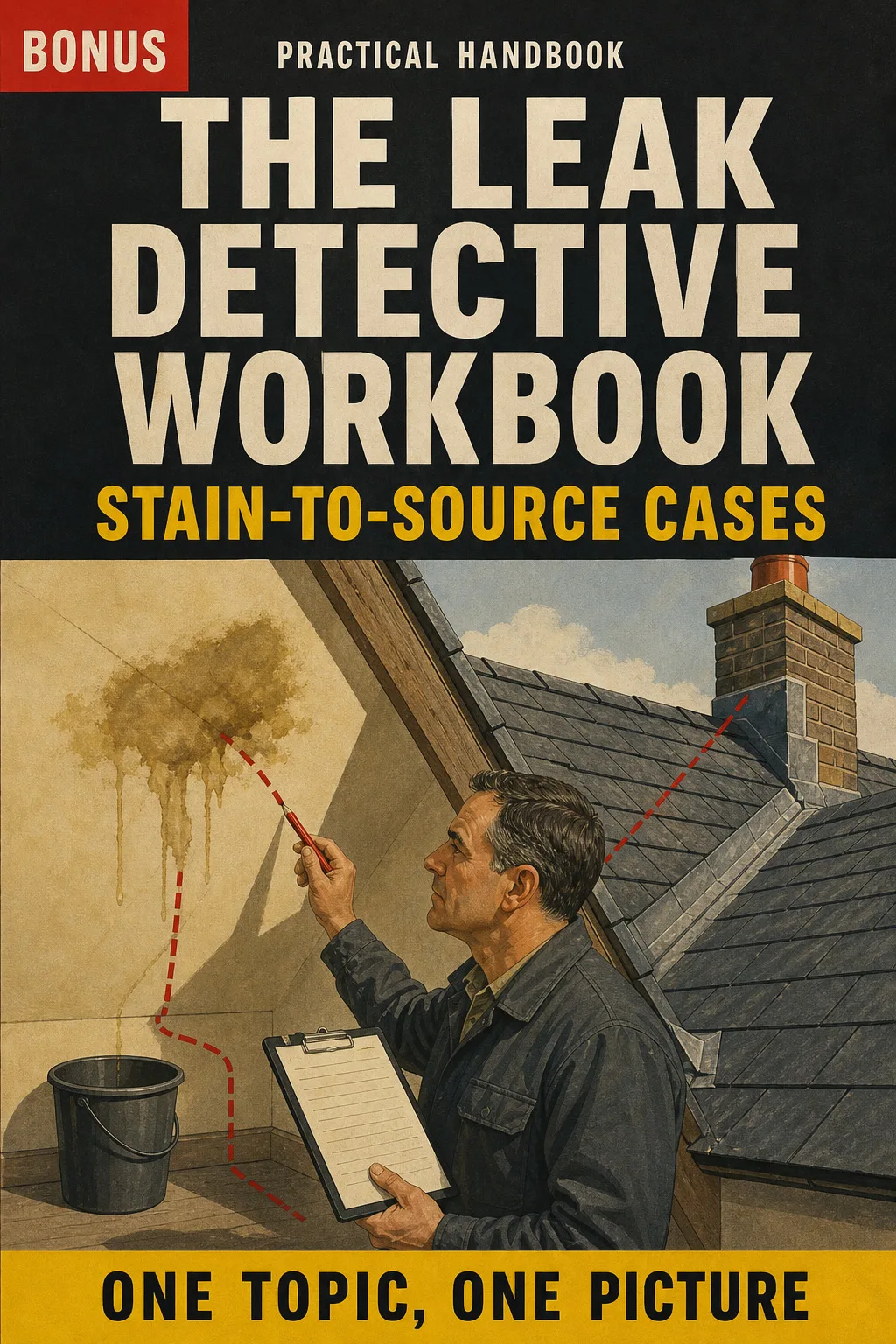
The Leak Detective Workbook: Stain-to-Source Cases

BONUS 1: «The Leak Detective Workbook: Stain-to-Source Cases»

Value on its own: US$ 17.90

Practise tracing water on drawn loft scenes, stain by stain, until you can read your own loft in the same order every time.

Before You Climb: Printable Roof Safety & Stop Cards

BONUS 2: «Before You Climb: Printable Roof Safety & Stop Cards»

Value on its own: US$ 14.90

One card per check to keep by the ladder: weather, footing, tying off, roof ladder, and the signs that mean this one is a roofer's job.

Pitched Roof Repair Illustrated with 2 Free Books

  • Pitched Roof Repair Illustrated: 68 illustrated pagesUS$ 63
  • BONUS 1: The Leak Detective Workbook: Stain-to-Source CasesUS$ 17.90
  • BONUS 2: Before You Climb: Printable Roof Safety & Stop CardsUS$ 14.90
  • High-resolution PDF to printIncluded
Total value US$ 95.80
YOUR PRICE:
US$ 27
You save US$ 68.80
YES, I WANT PITCHED ROOF REPAIR ILLUSTRATED FOR US$ 27

📄 This is a digital PDF book sent to your email: nothing is printed or shipped.

Secure purchaseEncrypted payment30-day guarantee

PDF by email: We email you Pitched Roof Repair Illustrated as a PDF, together with the two free books. It's a single payment: no installments, no extra charges.

Who This Book Is For

There's a stain on the ceiling

There's a stain on the ceiling

You go up to the loft with a torch and follow the same order every time: stain, timber, underlay, roof. You know where to look, not just where it drips.

You're waiting for the roofer

You're waiting for the roofer

You see what can be done safely now, what's a roofer's job, and what the words he'll use actually mean, all drawn page by page.

You look after an old house

You look after an old house

Slate or tile, ridge, valleys, lead and gutters, each one on its own page, plus a yearly check to tick and date every autumn and spring.

Everything You Get Today

US$ 95.80US$ 27
YES, I WANT PITCHED ROOF REPAIR ILLUSTRATED FOR US$ 27

📄 This is a digital PDF book sent to your email: nothing is printed or shipped.

30DAYS
GUARANTEE

30-Day Guarantee

Try Pitched Roof Repair Illustrated for 30 days, bonus books included.

We refund everything if the file won't open, if the book isn't what you see here, if you were charged twice or if the email doesn't arrive. Just email us.

You pay once. No subscriptions.

Frequently Asked Questions

Is it for me if I've never worked on a roof?

Yes. It starts with how a pitched roof keeps water out and covers natural slate (such as Welsh slate), plain clay tiles and concrete interlocking tiles. Every roof page has a safety box, and many checks are done from the loft or the ground. Each page says when to stop and call a roofer.

Where does the content come from?

It's checked against current UK guidance: HSE guidance on work at height and ladders, BS 5534 and BS 8000-6 for slating and tiling, guidance on rolled lead sheet and Approved Document L for roof renovation.

Is it official material?

No. It's an independent illustrated book. It isn't produced or endorsed by the HSE, BSI or any other body.

Does it replace a roofer or proper training?

No. It covers diagnosis and the small repairs a homeowner can do. Re-roofing, structural timber and any job that needs scaffolding are for a roofer, and you work at your own risk.

I've watched YouTube videos. What does this have that they don't?

It's written for UK houses: natural slate, plain clay tiles and concrete interlocking tiles, metric measurements, lead codes and current UK guidance, one topic per page, always in the same order. The building regulations page follows England; in Scotland, Wales and Northern Ireland, check with your local building control.

When and how does it arrive?

As a PDF by email, to the address you give at checkout. The 2 free books come the same way.

Do I have to pay every month?

No. It's a one-off payment. No subscription.

Can I have it on paper?

Yes. It's a PDF you can print at home, all of it or just the pages you need, and take up to the loft.

How does the refund work?

You have 30 days. We refund everything if the file won't open, if the book isn't what you see on this page, if you were charged twice or if the email doesn't arrive: just email us.

Before You Close This Page

No more ten videos saying ten different things.

The ladder angle, the tingle, the step flashing: you see it drawn and that's it.

You know what to check from the loft, and when to stop and call a roofer.

Drawings make studying faster.

The book is right below.

One-time payment: US$ 27 · Guarantee: 30 days · PDF by email

YES, I WANT PITCHED ROOF REPAIR ILLUSTRATED FOR US$ 27

📄 This is a digital PDF book sent to your email: nothing is printed or shipped.